20.03.2007 07:40
Financieel misbruik blijkt een zwaar onderschatte vorm van mishandeling. Om de drie dagen krijgt het Vlaams Meldpunt Ouderen Mis(be)handeling een klacht binnen van 55-plussers die bestolen werden door hun eigen familie.
Voor de correctionele rechtbank van Dendermonde starten dinsdag de pleidooien over een pijnlijke geldkwestie tussen twee familieleden. Een 82-jarige gehandicapte weduwe staat er lijnrecht tegenover haar nicht. De hoogbejaarde Césarine Van Den Stock eist 140.000 euro terug die haar nicht zou hebben gestolen. Zonder zich te willen uitspreken over deze concrete zaak benadrukt het Vlaams Meldpunt Ouderen Mis(be)handeling dat financieel misbruik een onderschatte vorm is van ouderenmishandeling. "In 2005 ontvingen we 402 klachten. Daarvan gingen er 135 over financieel misbruik. En het werkelijke aantal moet nog veel hoger liggen. Dat komt doordat er een taboe op rust door de nauwe banden tussen dader en slachtoffer", zegt beleidsmedewerker Anne Van Der Gucht. Want uit de cijfers blijkt dat de daders meestal de kinderen of andere familieleden zijn.
Bron: MSN Nieuws Binnenland België(SVR)
20 maart 2007


15 maart 2007
Teenager snubs the BBC's £8.5 million offer for his news website, Tiener laat 12 miljoen schieten
Tiener laat 12 miljoen schieten
Een 17-jarige Britse tiener kon 12 miljoen euro verdienen met zijn website. Maar de jongen heeft het bod afgeslagen. Nick Coates is de oprichter Sharpenews, een nieuwssite speciaal voor jongeren. Hij begon met de site toen hij 12 was, en het werd meteen een hit. De site lokte in het laatste anderhalf jaar 89 miljoen bezoekers. Wereldwijd werken er al zo'n 70 medewerkers voor de webstek.
http://www.sharpenews.co.uk
bron: MSN Reporter
Engelse versie is uitgebreider:
Teenager snubs the BBC's £8.5 million offer for his news website
Teenage media mogul Nick Coates is so confident he will one day be as successful as Rupert Murdoch that he snubbed an offer of £8.5 million pounds from the BBC for his youth news website.
Nick, just 17, is chief executive of Sharpenews Ltd, the first global news agency for young people, but says he's not interested in pocketing megabucks at the moment.
In the last 18 months the website has had 89 million hits, making the Cleeve School student one of the most successful IT entrepreneurs of his generation.
He's got 70 members of staff around the world, including a managing director and an accountant - all of them under 18 and all working as volunteers.
Last year the agency won US company Young Media's Website of the Year award.
Nick, who lives in Stanwick Gardens, Cheltenham, says he's several offers from media groups - and the BBC have even offered to take it of his hands for £8.5 million.
But he says he doesn't need the money himself yet, and ploughs all the profit back into the site.
The BBC would "ruin" his idea, he claims.
He added: "If I sold it, I'd take away about £4 million personally, but I'm not interested in doing that at the moment.
"The BBC offered me all that money because they don't have an equivalent service for young people, but to be honest I think they would ruin it. I can't say which individual it was, but the letter came from the board of directors.
"I think I can run it better myself and I worried that the BBC would employ older people to try and write young people's news, whereas at the moment we are run by young people for young people.
"BBC news goes right over my head, to be honest. Our young reporters gather news that interests them, and it seems to work.
"Juggling my business and school is tough. But I'm not in this for the money - in a few years perhaps but not now. I want to go on to university and work on youth projects in the future, perhaps abroad."
Nick, who is studying computing, IT, history and geography at A-level, set up the innovative site when he was just 12.
It was a basic text-only programme but still managed to attract 100 users a month. Now the suite makes £2,500 per month from advertising. Sharpenews offers readers 1000 news stories a month.
"I set the site up because alot of young people didn't have a website to view the news written in a way they would understand. I just thought, 'Why can't I correct that?'
"I have been stunned by the success. We've been going for five years, but in the last two years, internet news has really kicked off and we're benefitting from that."
Sharpenews Ltd is a limited company and Nick has 25 journalists who contribute from all over the world.
"Everyone involved is a volunteer, and doesn't get paid," he said. On top of running the firm, Nick still finds time to do his schoolwork and work 10 hours a week at Comet.
Luke's mum, Liz, a dinner lady, and his dad Ian, an optician, both 42, say they let him run the business under his own steam without meddling.
"We just let him get on with it - he's done very well so far and we are incredibly proud," said Liz.
To log onto the site visit www.sharpe-news.co.uk/sn/index.php
source of this news: http://www.dailymail.co.uk
Sponsored Link:
 |
rethinksociety |
| Naar deze groep gaan |
14 maart 2007
Het Valentijn-gevoel: instant-intimiteit in wegwerpverpakking

Het Valentijn -gevoel: instant-intimiteit in wegwerpverpakking
This time no English version
"Er is geen grotere leugen dan de liefde", lees ik ergens in het geharrewar van spielereien rond het fenomeen 'Sint-Valentijn' en zijn elitaire variant 'Saint-Amour'. Waar de mond van vol is, stroomt het hart van over. Of toch niet. Het is immers zo ver gekomen dat we, op basis van een spelletje vogelpik, één dag per jaar vurig minnestrelen om de overige dagen onverschilliger dan ooit rond de hete brij te dansen.
"I love you!", schreeuwen we uit volle borst op Valentijnsdag, waarna we heimelijk hopen op een dineetje bij kaarslicht in een fermette met minstens twee Michelin-sterren of wat rampetampen op boerenwijze in het idyllisch kader van een Ardeens kasteel. Met wie? Met de ideale man of vrouw. De ridder op het witte paard. De zeemeermin van Kopenhagen. Ziedaar alras de leugen in vol ornaat opduiken.
Want wie vaart er uiteindelijk wel bij de instant-intimiteit in wegwerpverpakking waarmee u op 14 februari om de oren wordt geslagen? Om te beginnen de reclamejongens. Vervolgens de horecasector en tenslotte de handel in accessoires en gifts of anders gezegd de voddemarchanten in onzin en rommel. Zeg nu zélf. Dat gedroomde weekend met uw geliefde in de bubbelende tobbe van een vijfsterrenhotel levert op 14 februari vaak niets meer op dan een beschamende koffiemok met de tekst 'Be my Valentine!' die u met plezier naar het donkerste hoekje van de hoogste kast verwijst. Of een boxershort met koddige hartjes die u nooit zal durven dragen uit vrees uitgelachen te worden in de kleedkamer van de plaatselijke voetbalploeg.
De enige ware verdienste van de viering van Sint-Valentijn is uiteindelijk dat het naderen van de grote dag menig hart op hol brengt. Vooral dan wanneer de vraag rijst of men nu al dan niet gevolg moet geven aan de lokroep van de commerciële liefde. Is Sint-Valentijn vieren politiek correct? Mag of moet u zich overgeven aan de wetten der verliefdheid en hoe moet u het aan boord leggen om niet al te bespottelijk over te komen? Uw onrust over het nakende gebeuren stemt u droef ten moede.
Het antwoord is eenvoudig. Leg uw ego even op de operatietafel en snijdt het vakkundig aan stukken. Ontdoe het van de nodige franjes en keer uw hersenspinsels binnenstebuiten. Bevraag u over uw diepere zelf en uw oppervlakkige verlangens. Hang wat over blijft aan de slagershaak en neem er even afstand van. Verlangt u nu werkelijk naar het brengen van een serenade onder het raam van uw geliefde? Hoopt u nu écht op een briefkaart van een stiekeme minnaar die zich vervolgens vleselijk kenbaar zal maken en u voor eeuwig en altijd trouw zal blijven, in goede en slechte tijden, ook wanneer u een slippertje maakt, en tot de dood u beiden scheidt in de vorm van een ijskoude graftombe van goedkope makelij?
Ik denk van niet. Uiteindelijk is uw zogenaamde streven naar bemind te worden, naar het krijgen van een eeuwigdurende relatie, au fond niet meer dan een voortdurend kibbelen om wissewasjes, naar zeuren aan elkanders hoofd om zogenaamde betrokkenheid. Want in het diepst van uw gedachten wil u helemààl geen relatie, geen liefde, geen verliefdheid, geen gerotzooi. En de meest doeltreffende methode om deze ideale toestand te verwezenlijken is het voortdurend onder spanning zetten van uzelf en uw omgeving. Dansen op het slappe koord van de onzekerheid om uzelf te sterken in de idee dat niets zeker is in het leven. Dat uw persoonlijke vrijheid voor altijd gegarandeerd blijft. Dat binden niet meer is dan verblinden.
Op Sint-Valentijn snelt u gemakzuchtig als u bent even naar de dichtsbijzijnde shopping mall om u een overdosis instant-intimiteit in wegwerpverpakking aan te schaffen. Oef! Daar bent u dan weer een jaartje vanaf. Zo meteen kan u zich weer met de toewijding van een non ten tijde van Tijl Uilenspiegel storten op het creëren van afstand tot uw naaste, uw medemens, uw tegenpartij, uw rotgenoot.
Beste binnenvetters, Valentijngelovigen, strebers en voddemarchanten. Bemin uzelf zoals geen ander. De liefde, en niets dan de liefde, voor uw gammele zelf leidt naar de top van de roem. Warm op Valentijnsavond uw bordje 'ego' op in de microwave, barricadeer de deuren, zet uw lievelingsmuziek op of laat de wastobbe vollopen. Knip uw teennagels en strooi ze rijkelijk uit over het kamerbreed tapijt. Strijk neer in uw eigen zelfgenoegzaamheid, wentel uzelve in de mooiste gedachten, laat uw fantasie de vrije loop, sla de hand aan uzelf of lees een goed boek. En bedenk dat er maar één dag per jaar is waar u ten volle aan uzelf moet denken. Valentijnsdag. Onder het motto: "Alles voor uzelf en niks voor een ander". Zodat u eindelijk met uw beminde zelf in het reine kan komen en zonder angst en pijn kan inslapen. Eén keer per jaar uzelf graag zien, dat is toch niet teveel gevraagd, zeker?
Reacties kan je lezen/plaatsen in ons forum
Bron: www.femistyle.be
Tekst: Erika Claessens
Gap among Jews widens on question of Zionism - Rabkin
Gap among Jews widens on question of Zionism - Rabkin
Deze keer geen nederlandse versie
By Yakov M. Rabkin
Originally published March 8, 2007
A profound division has developed between Zionist advocates of Israel and Jews, secular and religious, who reject or question Zionism and actions taken by the state of Israel.
Public debate about Israel's place in Jewish continuity has become open and candid.
Advertisement
Many Jews try to come to terms with the contradictions between the Judaism they profess to adhere to and the Zionist ideology that has taken hold of them. This coincides with serious concerns expressed across Israel's political and religious spectrum about the future of Israel.
Quite a few Jews now publicly ask whether the chronically besieged ethnic nation-state in the Middle East is "good for the Jews." Many continue to be concerned that militant Zionism destroys Jewish moral values and endangers Jews in Israel and elsewhere. This debate has entered pop culture as well: The recent film Munich by Steven Spielberg sharply focuses on the moral cost of Israel's chronic reliance on force.
The Israel lobby in the United States, aligned with the nationalist right in Israel, viciously attacked the Jewish director and his film even before it was released. It also lashed out at several books published over the past few years - Prophets Outcast, Wrestling With Zion, The Question of Zion, The Myths of Zionism - all authored by Jews who are concerned about the same essential conflict between Zionism and Jewish values.
A few weeks ago, the Israel lobby (through its constituent American Jewish Committee) issued a report alleging that Jews who criticize Israel endanger its "right to exist" and foment anti-Semitism. This provoked a number of prominent Jews in Britain, Canada and the United States to speak out, moving candid debate about Israel into mainstream, even conservative, publications. In January, the eminently pro-establishment Economist published a survey of "the state of the Jews" and an editorial that called on rank-and-file Diaspora Jews to move away from the "my country, right or wrong" attitude adopted by many Jewish organizations.
Making a stand for Jewish emancipation from the state of Israel and its policies has bridged some old divides and created new ones. Thus, an ultra-Orthodox critic of Israel, usually antagonistic to Reform Judaism, commended a Reform rabbi for saying that "when Israel's Jewish supporters abroad don't speak out against disastrous policies that neither guarantee safety for her citizens nor produce the right climate in which to try and reach a just peace with the Palestinians ... they are betraying millennial Jewish values and acting against Israel's own long-term interests."
Their relationship with the state of Israel and with Zionism has polarized the Jews. The axis along which this polarization has taken shape does not correspond to any of the habitual divisions: Ashkenazi/Sephardic, observant/nonobservant, Orthodox/non-Orthodox.
In each of these categories are Jews for whom national pride, even arrogance (chutzpah), is a positive value, and who give their enthusiastic support to the state that incarnates what they identify as a life force, a triumph of the will and a guarantee of Jewish survival.
But each of these categories also includes Jews who believe that the very idea of a Jewish state, and the human and moral price that it demands, undermines all that Judaism teaches, particularly the core values of humility, compassion and kindness. They, along with Israel's staunchest supporters, point up the paradox that has seen Israel, often presented as an ultimate haven, become one of the most precarious places for Jews. Israeli media report unprecedented levels of concern not only for the future of the state but also for the physical survival of its inhabitants.
Some attempt to redefine "Israel's national purpose" as a means to revitalize Israel's largely demoralized society.
Divisions about Israel and Zionism are so acute that they may split Jews as irremediably as did the advent of Christianity two millennia ago. Christianity, which embodies a Greek reading of the Torah, eventually broke away from Judaism. Like Christianity, Zionism, reflecting a nationalist, romantic reading of the Torah and Jewish history, has come to fascinate many Jews.
It remains to be seen whether the fracture between those who hold fast to Jewish moral tradition and the converts to Jewish nationalism may one day be mended. However fateful for Jews and Judaism, this fracture may not necessarily affect Israel, which nowadays counts many more evangelical Christians than Jews among its unconditional supporters.
Yakov M. Rabkin, author of "A Threat From Within: A Century of Jewish Opposition to Zionism," is professor of history and associate of the Centre for International Studies at the University of Montreal. His e-mail yakov.rabkin@umontreal.ca.
Copyright © 2007, The Baltimore Sun
07 maart 2007
Dolce & Gabbana zet nieuwe campagne stop, D&G stops new ad campaign English version Below
Dolce & Gabbana zet nieuwe campagne stop
Het Italiaanse modehuis Dolce&Gabbana zal hun nieuwe controversiële reclamecampagne verwijderen. Op de foto's is een vrouw te zien die bij haar polsen wordt vastgehouden door een halfnaakte man.
Het modeduo Dolce&Gabbana kon zich eigenlijk geen betere reclame inbeelden. Sinds hun nieuwe campagne van start ging, regent het klachten over de controversiële advertentie. Een vrouw wordt, tegen haar zin, door een man met bloot bovenlijf vastgehouden bij de polsen. Vier andere mannen staan naar het gebeuren te kijken. Volgens sommige Italiaanse groeperingen zou dit soort reclame aanzetten tot huiselijk geweld of erger, groepsverkrachtingen. Ook minister voor Gelijke Kansen Barbara Polastrini moeide zich al met het debat en eist dat de beelden worden verwijderd. Er werd zelfs gedreigd met een volledige boycot van het merk. Zo ver liet het modeduo het niet komen en stopte met de campagne. "We hebben besloten om de campagne stop te zetten, " zeggen de twee. "We hadden nooit gedacht dat deze foto zoveel boosheid zou losmaken. Het is ook nooit onze bedoeling geweest om iemand te kwetsen en zeker niet om geweld tegen vrouwen te promoten." (ACK)
Bron: MSN nieuws
English version
Dolce & Gabbana plans to pull the advertisement, which shows a man holding a woman to the ground by her wrists while a group of men look on, following complaints from consumers' groups.
Italian fashion house Dolce & Gabbana has branded Spain as being 'behind the times' for demanding it withdraw a controversial advertising campaign, a newspaper reported on Friday.
Dolce & Gabbana plans to pull the advertisement, which shows a man holding a woman to the ground by her wrists while a group of men look on, following complaints from consumers' groups. "We will only withdraw this photo from the Spanish market. They're a bit behind the times," La Vanguardia newspaper quoted the Milan-based fashion house as saying.
Dolce & Gabbana, known for their risque clothes and adverts, declined to comment on the matter.
Spain's Labour and Social Affairs Ministry branded the campaign as illegal and humiliating to women, saying the woman's body position had no relation to the products Dolce & Gabbana were trying to sell.
"One could infer from the advertisement that it is acceptable to use force as a way of imposing oneself on a woman, reinforced by the passive and complicit manner of the men looking on," the ministry said in a statement.
Dolce & Gabbana defended the campaign as art in comments reported by La Vanguardia. "What has an artistic photo got to do with a real act?" the paper quoted the firm as saying. "You would have to burn museums like the Louvre or the paintings of Caravaggio."
The fracas follows criticism from Britain's advertising watchdog last month about another Dolce & Gabbana campaign showing models brandishing knives.
The British Advertising Standards Authority upheld more than 150 complaints from people concerned that the pictures glorified and condoned violent crime. In that case, the company said the ads were heavily stylised and mimicked early 19th century art.
source: http://www.thefashionspot.com/forums...
other D&G related story
Stop, theres more: Dolce and Gabbana ad controversy Friday, August 04, 2006
Dolce and Gabbana respond to the Puma (hetro) ad with this (almost a blow job) ad..

source: http://gay-news.blogspot.com
03 maart 2007
Off Topic, even tussendoor, Dolce Gabbana ad protest in italy, Nederlandstalige versie beneden

source:
adrants.com
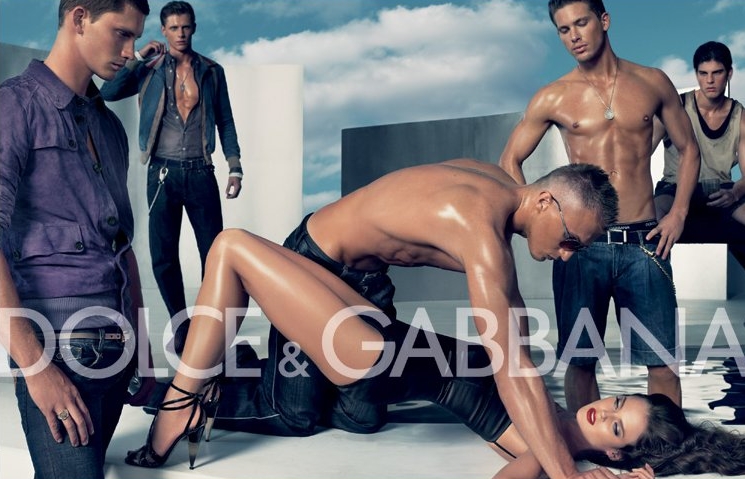
Dolce & Gabbana Ad: Cartoonish Edginess or Gang Rape? source: http://www.adrants.com
What, exactly, is going on in this Dolce & Gabbana ad and does it really matter? Don't fashion labels get a pass when it comes to raciness and imagery that connotes culturally questionable activities? According to National Organization for Women President Kim Gandy who told BrandWeek, "It's a provocative ad but it is provoking things that really are not what we want to have provoked. We don't need any more violence," the answer is no. Her organization plans to protest the ad and has added to a section of its website that highlights ads it feels are offensive.
One could argue the ad certainly paints a questionable picture and perpetuates an activity that certainly does not need perpetuating. Others might argue the ad, and many other fashion ads, is so over-the-top cartoonish in its desire to be "edgy," that it's a harmless toss off passed over as one glosses through the fake world of fashion magazines. What do you think?
Written by Steve Hall Comments (32) File: Campaigns, Magazine, Racy, Trends and Culture Feb-20-07
read the comments!: click here
other source: http://www.brandweek.com
other source: www.talkaboutdesign.com
Nederlandstalige versie:
Protest in Italië tegen reclamefoto Dolce&Gabbana
Een reclamefoto van de Italiaanse modemaker Dolce&Gabbana heeft in Italië protest uitgelokt.
"Dat is aanzetten tot groepsverkrachting", fulmineerde minister voor Gelijke Kansen Barbara Polastrini net als meerdere politici uit verschillende politieke partijen. Op de foto is een man met naakt bovenlijf te zien die een vrouw vasthoudt die op haar rug op de grond ligt en van wie blote benen te zien zijn. Meerdere mannen kijken toe op het tafereel. De minister eist dat de reclame wordt ingetrokken. Ook vakbonden komen met deze eis en dreigen ermee een oproep tot boycott van Dolce&Gabbana te lanceren, aldus Italiaanse kranten. Beide stylisten hebben nog niet op het protest gereageerd. Toen er onlangs in Spanje gelijkaardig protest kwam, lieten zij gelden dat de foto een kunstwerk is. (LVK)
bron : MSN Nieuws
src="http://pagead2.googlesyndication.com/pagead/show_ads.js">
01 maart 2007
Hits, hits, hits, nederlandse versie beneden
Dit overzicht is niet beschikbaar.
Klik hier om de post te bekijken.
Abonneren op:
Posts (Atom)